Ruvqiron
Luma Pathway
Luma Pathway
Couldn't load pickup availability
Share
- Problem Statement
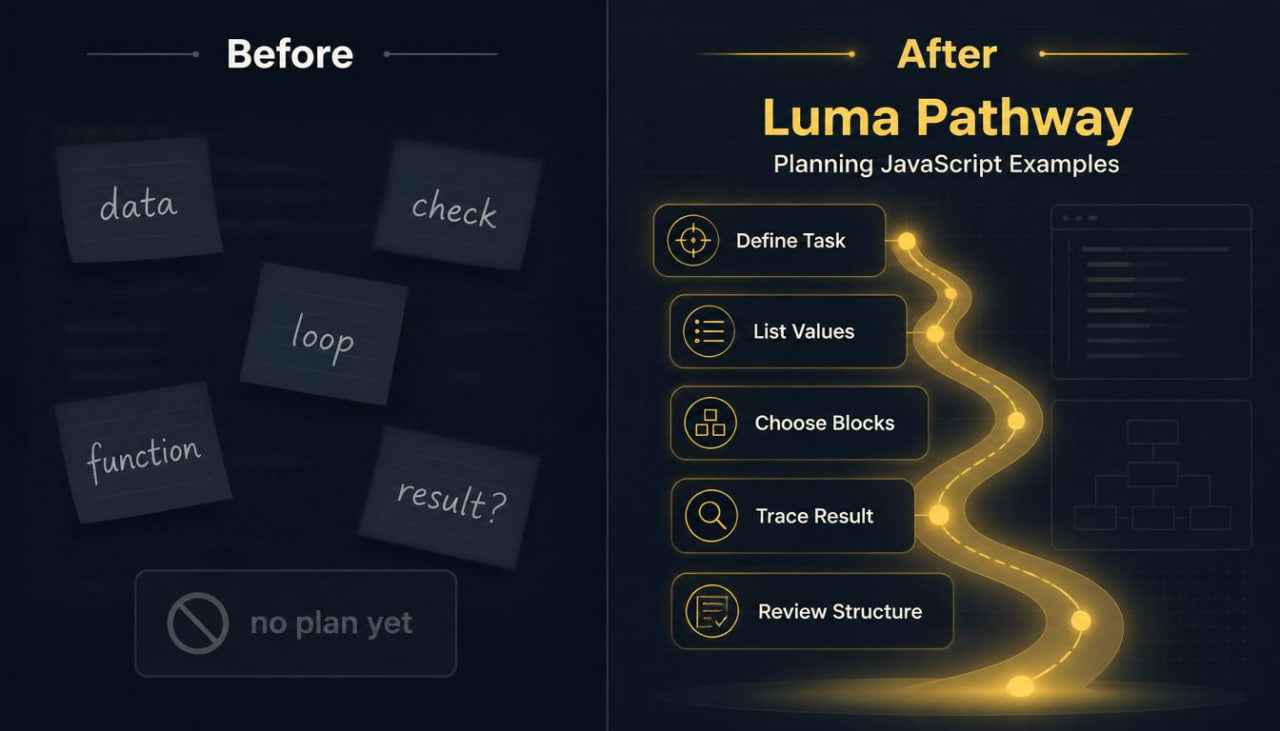
At this point in JavaScript study, learners often understand many separate topics but still feel unsure when they need to plan a full example from the beginning. A task may require grouped information, several checks, repeated actions, and functions that work together. Without a clear reading method, the code can feel like a collection of parts rather than one connected idea. Learners may also find it difficult to decide where a value should begin, where it should change, and where the final result should appear. Luma Pathway was created for this stage, where the learner needs more guided structure and more practice with planning JavaScript examples.
- Solution
Luma Pathway organizes JavaScript study around planning, reading, and building connected code samples. The materials show how to begin with a simple goal, divide it into smaller parts, and then arrange those parts into readable JavaScript blocks. Learners study arrays, grouped information, functions, conditions, loops, and returned values through detailed examples. Each module includes explanations, practice tasks, review notes, and code-reading prompts. The course is intended to help learners improve the way they approach JavaScript examples before writing or editing them.
- What’s Inside
Luma Pathway includes a broader set of Ruvqiron JavaScript materials focused on planning and structured practice. The opening module introduces the idea of a code plan. Learners study how to look at a task and identify the main pieces before reading or writing code. This includes finding the starting information, deciding what needs to be checked, identifying repeated actions, and describing what result the code should produce.
The next module focuses on structured data. Learners review how related details can be grouped with named properties and how several grouped items can be placed inside arrays. The examples show how to read one item, compare items, and work with several values inside the same structure. Each example includes notes that point out the role of names, values, and relationships between pieces of information.
A detailed section explains how to build small data-reading patterns. Learners study examples where code reads a group of items, checks one property, compares values, and returns a simple result. The materials show how to move through the example slowly, starting with the data and ending with the result. Practice tasks ask learners to mark the data section, describe the check, and explain what the final line gives back.
Luma Pathway also includes a module on functions as planning tools. Instead of treating functions only as code blocks, the course explains how they can help separate one task from another. Learners review examples where one function prepares information, another checks a value, and another returns a result. The material highlights function names, input values, internal steps, and returned results.
Another section focuses on conditions inside fuller examples. Learners study how conditions can guide a code path when several outcomes are possible. The examples include single checks, grouped checks, and conditions placed inside repeated actions. Each sample includes a short explanation of what is being tested, what happens next, and how the condition affects the final result.
The course also includes a module on loops with planned structure. Learners review how repeated actions can move through arrays and grouped items. The materials explain how to identify the loop start, the item being reviewed, the condition inside the loop, and any value that changes during repetition. Practice prompts ask learners to trace one loop step at a time and describe the movement in plain wording.
Luma Pathway includes a section on returned values and result handling. Learners study how a function gives back a value and how that value can be used in another part of the example. The materials show how returned values connect with naming, conditions, arrays, and grouped data. This section helps learners understand why the final line of a function matters and how it connects to the wider code sample.
A larger practice area is included for multi-step examples. These tasks guide learners through short planning notes before code review. A learner may be asked to identify the goal, list the needed values, mark the repeated action, write a short explanation for a function, or compare two different ways to arrange the same example. The tasks focus on careful review and practical understanding.
Luma Pathway also contains code-reading worksheets. These worksheets are designed as guided pages where learners can break a JavaScript example into parts. A page may include spaces for “starting data,” “condition,” “loop,” “function role,” and “returned result.” This gives learners a clear way to review code without trying to understand every line at once.
The tier includes review blocks after each main topic. These blocks summarize the module and connect it to earlier material. For example, a review after the structured data section links arrays, properties, loops, and conditions. A review after the functions section links input values, internal logic, returned values, and naming.
A glossary is included with terms used throughout the materials. It explains words such as grouped data, property, returned value, function input, repeated action, condition branch, code plan, item check, and result handling. Each definition is written in plain wording and connected to examples from the course.
- Who Is This For?
Luma Pathway is for learners who already understand JavaScript basics and want more practice with planning and reading connected examples. It is suitable for learners who have studied variables, arrays, loops, functions, conditions, and grouped information. This tier is helpful for people who can read short examples but want more structure when examples contain several blocks. It fits learners who prefer written materials, guided tasks, review pages, and detailed explanations. Luma Pathway is also useful for learners who want to improve how they approach JavaScript examples before moving into larger practice sets.
- What You’ll Learn
- How to plan a JavaScript example before reviewing the code
- How to identify starting information inside a task
- How grouped data is arranged with named properties
- How arrays can hold several related items
- How loops move through grouped information
- How conditions guide different code paths
- How functions separate one task from another
- How input values move into a function
- How returned values connect to the wider example
- How to trace one value across several blocks
- How to read multi-step JavaScript samples in smaller parts
- How to compare two versions of the same code idea
- How to use worksheets for code review
- How to explain JavaScript logic in plain wording
- Refund Terms
Luma Pathway includes a 30-day refund review period for paid course materials. If the materials do not match the description shown on the store page, you can contact Ruvqiron within 30 days after purchase. Please include your order details and a short note about the request. The message will be reviewed according to the store policy, and you will receive a reply with the next steps.
Self-paced learning overview
- 📁 Digital file available after purchase
- 🗂️ Long-term availability
- 🔒 Secure checkout
- 🗓️ Content updated in 2026
What format are the Ruvqiron course materials provided in?
What format are the Ruvqiron course materials provided in?
The Ruvqiron course materials are provided as digital learning files. They are created for reading, practice, review, and self-paced study. Each tier has its own amount of modules, examples, tasks, and learning notes.
Do I need previous JavaScript knowledge before starting?
Do I need previous JavaScript knowledge before starting?
No previous JavaScript study is needed for the starting tier. The first materials introduce basic ideas in a calm and structured way. Wider tiers add more topics, more practice tasks, and more detailed explanations.
How can I study the materials?
How can I study the materials?
You can study the materials at your own pace. Each module can be read separately, reviewed again later, and used with practice tasks. The course structure is made for learners who like organized written explanations and coding examples.