Ruvqiron
Pulse Guide
Pulse Guide
Couldn't load pickup availability
Share
- Problem Statement
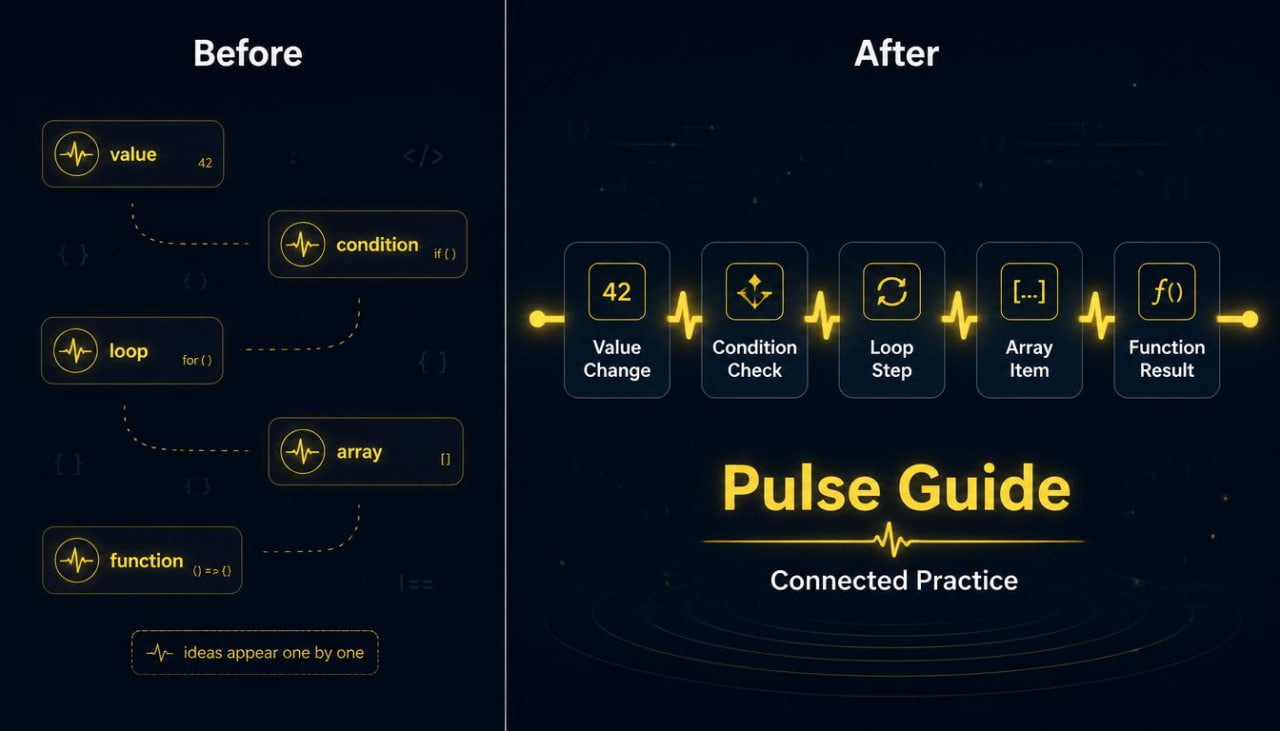
After learning the first JavaScript basics, many learners begin to face a new difficulty: the topics are no longer isolated. A variable may appear inside a condition, a condition may appear inside a loop, and a function may include several smaller ideas at once. This can make code examples feel crowded, even when each individual concept has already been introduced. Learners may understand what a variable is but feel unsure when that variable changes inside a repeated action. Pulse Guide focuses on this middle point, where the learner needs more connected examples and more guided practice.
- Solution
Pulse Guide organizes JavaScript topics around connection and repetition. Instead of presenting each idea as a separate island, the materials show how values, conditions, loops, and functions can work together inside small examples. Each module introduces a topic, explains its role, and then places it beside earlier ideas so the learner can observe how the pieces interact. The course uses written explanations, short code samples, practice prompts, and review notes to keep the study flow steady. It is intended for learners who want to improve their understanding of JavaScript logic through structured reading and practical tasks.
- What’s Inside
Pulse Guide includes a broader set of Ruvqiron JavaScript materials focused on beginner-to-intermediate study. The first module revisits variables and values, but with more context than the earlier tier. Learners review how a value can be created, changed, compared, and passed into another part of a code sample. This module also explains why naming choices matter when examples become longer. The goal is to help learners read code with more attention to how information moves from one line to another.
The next module focuses on conditions in a more detailed way. Learners study simple condition blocks, multiple branches, comparison checks, and nested examples. Each example is written with commentary that explains what the code checks first, what happens when a condition is met, and what happens when it is not met. This section also includes practice tasks where learners rewrite condition examples using different values and outcomes.
Pulse Guide also introduces loops as a core topic. The materials explain why repeated actions are used in JavaScript and how a loop can help work through a list of values or repeat a small instruction. Learners review loop structure, starting points, stopping points, and changes that happen during each repetition. The examples stay compact at first, then gradually include variables and conditions so learners can see how the topics connect.
A separate section focuses on arrays. This part explains arrays as ordered groups of values. Learners study how values can be placed inside an array, how positions work, and how a loop can move through several items. The materials include examples with text values, number values, and simple mixed practice tasks. Each task asks the learner to read carefully, identify what changes, and describe what the code is doing.
Pulse Guide also includes a module on functions with parameters and return values. Learners review how a function can receive information, work with that information, and send back a result inside a code example. The explanations stay close to practical reading: what goes into the function, what happens inside the function, and what comes out of it. Practice tasks include filling in missing parts, comparing two function examples, and writing short notes about what each function does.
Another part of the course introduces small logic patterns. These are not large projects, but compact examples that combine several ideas. A learner may review a short example that checks a value, loops through an array, calls a function, or returns a result based on a condition. The materials show how to break the example into smaller parts before reading it as one full block.
Pulse Guide includes detailed practice pages after the main modules. These pages are built around observation, rewriting, and explanation. Some tasks ask the learner to adjust a variable and predict how the code changes. Other tasks ask the learner to complete a missing condition, rewrite a loop, or describe why a function returns a certain value. The practice section gives learners room to work with code rather than only read about it.
The course also includes review blocks for repeated study. These blocks summarize the main points after each topic and bring earlier ideas back into view. For example, after the loop section, the review block connects loops with variables, stopping conditions, and arrays. After the function section, the review block connects parameters, returned values, and reusable code structure.
A glossary is included for the terms used across this tier. It covers array, index, loop, condition branch, parameter, return value, comparison, iteration, and related beginner-to-intermediate vocabulary. Each definition is written in plain wording and tied to the examples used in the course.
Pulse Guide also includes reading notes that help learners approach longer examples. These notes explain how to identify the starting value, how to follow changes across several lines, how to track repeated actions, and how to separate a function into input, internal steps, and returned result. This makes the tier useful for learners who want to develop stronger code reading habits.
- Who Is This For?
Pulse Guide is for learners who already understand the first JavaScript ideas and want a wider study path with more connected examples. It is suitable for people who have reviewed variables, values, simple conditions, and basic functions, but want more practice with how these topics work together. This tier is also helpful for learners who feel comfortable reading short code lines but need more support when examples contain several steps. It fits learners who prefer written materials, practical tasks, and careful explanations. Pulse Guide can also be used as a review tier for anyone who wants to strengthen their understanding of loops, arrays, function flow, and small logic patterns.
- What You’ll Learn
- How variables can change across several lines of code
- How conditions work with different branches
- How comparison checks guide code behavior
- How loops repeat small actions
- How arrays store ordered groups of values
- How array positions are used in examples
- How loops and arrays can work together
- How functions receive values through parameters
- How return values are used in code samples
- How to read small logic patterns step by step
- How to rewrite short JavaScript examples for practice
- How to explain what a code block is doing in your own words
- How to connect earlier JavaScript topics with new examples
- How to use review blocks for steady topic repetition
- Refund Terms
Pulse Guide includes a 30-day refund review period for paid course materials. If the course materials do not match the description shown on the store page, you can contact Ruvqiron support within 30 days after purchase. Please include your order details and a short explanation of the request. The support team will review the message and reply according to the store policy.
Self-paced learning overview
- 📁 Digital file available after purchase
- 🗂️ Long-term availability
- 🔒 Secure checkout
- 🗓️ Content updated in 2026
What format are the Ruvqiron course materials provided in?
What format are the Ruvqiron course materials provided in?
The Ruvqiron course materials are provided as digital learning files. They are created for reading, practice, review, and self-paced study. Each tier has its own amount of modules, examples, tasks, and learning notes.
Do I need previous JavaScript knowledge before starting?
Do I need previous JavaScript knowledge before starting?
No previous JavaScript study is needed for the starting tier. The first materials introduce basic ideas in a calm and structured way. Wider tiers add more topics, more practice tasks, and more detailed explanations.
How can I study the materials?
How can I study the materials?
You can study the materials at your own pace. Each module can be read separately, reviewed again later, and used with practice tasks. The course structure is made for learners who like organized written explanations and coding examples.